Wednesday, September 10, 2008

Going out with a bang

I am thrilled to announce that I have a "publication" in Nature, one of the two most prestigious journals in the natural sciences. It's just a short comment on another paper (in the "Brief Communications Arising" category), but it is peer reviewed and it is in Nature, so I guess it counts! It's a nice high point to end my academic career on! The peer review process was pretty funny. It was like a parody of the peer review process--we had 4 reviewers and two rounds of review that took about 6 months, all for about 3 paragraphs of text!! The first paragraph is here--access to the full text requires a subscription.

Below I'll summarize (or more likely, expand! actual science content!) what we did, but first I need to define the term "reanalysis". Weather forecasts these days are made by taking all the available observations (from surface stations like at the airport, from "weather balloons" which measure temperature, humidty and wind up through the atmosphere at a given point, and from satellite observations) and dropping them into a computer model which is based on physical principles. The crank is turned and then it spits out a forecast for 0, 6, 12, 18, etc hours in the future. Yes, it actually makes a current situation "forecast" which covers the whole globe rather than just where the observations are. This output is called an "analysis". For a long time in the 80s and 90s the output of these model runs was being saved and people got the idea to look at long term changes in in climate in the output. This was a good idea with a major flaw--the forecasting models get updates all.the.time, so no one was sure if trends in the output were real or just from changing models. Eventually they took the latest model available and started over at the beginning (1948), hence creating a re-analysis. One of the incredibly useful things about reanalysis is that it can span gaps in coverage, so we get output in regions like the north pole where there really aren't many measurements. Of course, such output is obviously not as reliable in these "data sparse" regions.


The original paper, published by Graversen, et al. in Nature (volume 451, pages 53-56, Jan 3, 2008), looked at trends in the Arctic in one of these reanalysis products (the "ERA-40" one). They averaged the data for all longitudes for the summer half of the year and looked at trends from 1979-2001. (They started in '79 because that's when the bulk of the satellites came online, and stopped in '01 when the ERA-40 project ended.) They then did something interesting--they looked at how these temperature trends varied as you move from 30N to 90N, and as you move from the earth's surface up to about 10km up in the atmosphere. This last piece is really interesting (and is what I've been trying to work on for the past three years) because knowing where the warming is happening (at the ground, higher up, throughout the whole atmosphere) can give you a clue about what is behind the warming. Different causes of warming like greenhouse gases, solar variability, urbanization, will all have a "signature" of warming at different heights, so it's another way to help us disentangle what's going on with the climate system.

So, Graversen, et al. found a huge peak of the warming trend over the Arctic Ocean (85-90N) in summer at about 3km above the ground. This result was really puzzling and unexpected, and seemed to indicate that, whatever was going on in the Arctic, it wasn't being driven by greenhouse gases.

Since my phd thesis has been on historical weather balloon data (back to 1932) with a special focus on the vertical profile of temperature in the Arctic, we decided to take a quick look at this. We recreated the problematic figure from the original paper using the ERA-40 reanalysis, but then we took ERA-40 and kept only those locations where weather balloons are ingested and looked at trends from that, and finally looked at trends in the weather balloon data itself. The last two versions matched each other quite well, which isn't surprising given that all the weather balloon data is ingested into the reanalysis, and confirms that where there is data, the output is pretty good. The problem came over the Arctic Ocean and it turns out there are a couple of issues:
  1. We discovered, in the primary reference paper for ERA-40 reanalysis, the discussion of a known problem ingesting satellite temperatures over the Arctic Ocean. It turns out that the data prior to 1996 was ingested with an error and the data after that without the error, leading to a jump in temperatures over the Arctic Ocean right at about 3km above the surface. An upward jump in the middle of a long series of data will give you a trend!
  2. The lack of weather balloons in the area meant that there was nothing to keep the model "on track", allowing this satellite error to dominate the region.

Point 2 isn't so surprising--no one expects the models to be perfect. What I did find really surprising was that the reviewers of the original paper let stand the trends in such a poorly validated region, especially in light of the known error (point 1 above). It seems like a pretty big oversight to me!

Labels:

Wednesday, August 06, 2008

Really bad ideas

Zuska had an interesting post about the use of sexual metaphors in computing (specifically at a hacking summer camp)--things like "penetration" or "violation". I commented about how it reminded me of my undergrad days when I spent a couple of years working in a physics lab building electronics instrumentation. One of the components used to build analog circuits is a resistor, a tiny blob of carbon (or something equally not-very-conductive) painted with colored stripes to denote the magnitude of resistance that that resistor provides. Most people found the color code hard to remember, so there are all kinds of mnemonics to help out. The first one I was taught* was "Black Boys Rape Our Young Girls, But Violet Goes Willingly for Silver or Gold" (occasionally people would tone it down by saying "bad boys..."). Yikes! I'm almost as speechless now as I was 20 years ago. And, hey, way to make the first woman in your research group feel welcome!

In electronics there are also all kind of connectors (like the one from the TV to the, uh VCR? ok, DVD!) which were referred to as "male" and "female" connectors, for obvious reasons**. Anytime I was around someone I hadn't worked with before, the first mention of these would be followed with an awkward pause while everyone in the room had my (female) anatomy flash through their minds. Or it would be followed by some ribald jokes (sometimes these would continue even around people I had worked with for a long time). This is a good example of the kind of "uncomfortable climate" or culture that makes me think twice about being a scientist--do I really belong? Do I want to put up with this for the next 40 years? All these kinds of events that magnify our Otherness can have this kind of very subtle impact. But because each individual event is so small, it seems kind of silly to point to them individually. It's well known, however, that these things really do add up over time and also in quantity.


*Incidentally (and luckily), I never had trouble with the color code because it's simply black-brow-the_spectrum-grey-white-silver-gold. The spectrum was one of those things that seemed to come naturally to me, and even as a very small child I was pretty neurotic about needing my colored pencils to be in rainbow order! in their case. Ahem. And with the resistors, the package around the spectrum was just a fade out from black to white. I never had trouble remembering left from right either--it's funny how people just get that as a toddler or they never do (their entire lives!).

**I have to confess that some of the "male" connectors had such large and deep "foreskins" that I would occasionally get a bit confused!

Labels: ,

Friday, April 18, 2008

Moving target

When I was five, I announced that I was going to be an airplane pilot when I grew up, and that I would fly a pink jet. This amused my parents to no end. Aside from the pink fixation, I was not a girly girl, playing exclusively with my Legos, Tinker Toys, and this horrible old electric train set that filled the whole basement with smoke.


In high school, I wanted to be an auto mechanic. I went to a votech school for grades 9-11 and took tons of shop my freshman and sophomore years (including the woodworking class where I clocked my teacher in the head with a 2x4 that was over my shoulder. Oops!). When I had to choose a "major" my junior year, though, I wound up picking drafting. If I'd taken automotive, I wouldn't have been able to take any more math or science.


My senior year in high school, I switched to a regular school and buried myself in another world. I took western civ, latin, and as many writerly-type things as I could find. Now I wanted to be a writer.


This dream took me through the first year of college at The Evergreen State College. Evergreen is an "alternative" school where you mostly take one (massively interdisciplinary) "class" for an entire year. My first year I took "Great Books". We read a book a week--yeah, a book being Homer's Illiad or Plato or Aristotle--and attended a lot of seminars and wrote an essay about the book. I don't remember any of it. One of the core professors was a physicist and I developed a huge crush on took a real liking to him, so I decided to take whatever "class" he was teaching the next year.


That turned out to be "Energy Systems", which covered the math and science and technology behind how we create and use energy in the world, from coal fired power plants to internal combustion engines to solar panels. We also looked at the social implications of technology. That year was about the best year of my life. I absolutely loved the class and loved being back in science. Suddenly, every question had a right and a wrong answer, and if I worked hard enough, I could usually find it. Even if I couldn't figure them out myself, just knowing the correct answer existed seemed comforting to me. I also had a sweet internship at the Thurston County Solid Waste Department writing a report about cloth versus disposable diapers, instigating my lifelong secret obsession with solid waste. I'm fascinated by garbage and all things municipal.


But Evergreen doesn't really let you "major" in anything, so after that year I left and moved to San Francisco, to study physics at SF State. I loved that department, and more good times were had. I worked as a research assistant in the Underwater Acoustics Group, and I even had a fun internship in the theoretical physics department at Ford Motor Co. (No, I didn't know there was such a thing, before the job offer.) I decided I would eventually work in research and development in industrial physics, or possibly at a government lab. This meant I needed a PhD in Physics (or something close).


But first, I wanted to take a few years off and work. I found a great job as a development engineer at QualiTau, right in the heart of Silicon Valley. There I designed some new electronic instrumentation and wrote some software. And got thoroughly sick of the semiconductor industry which is a crazy, manic, cutthroat kind of industry.


Then I started a PhD in materials science at the Univ. of Minnesota. I'd promised myself I wouldn't work in semiconductors anymore .... and wound up in a semiconductor research group. I flailed away at a flawed idea for a couple of years, but my heart wasn't in it.


I needed an adventure.


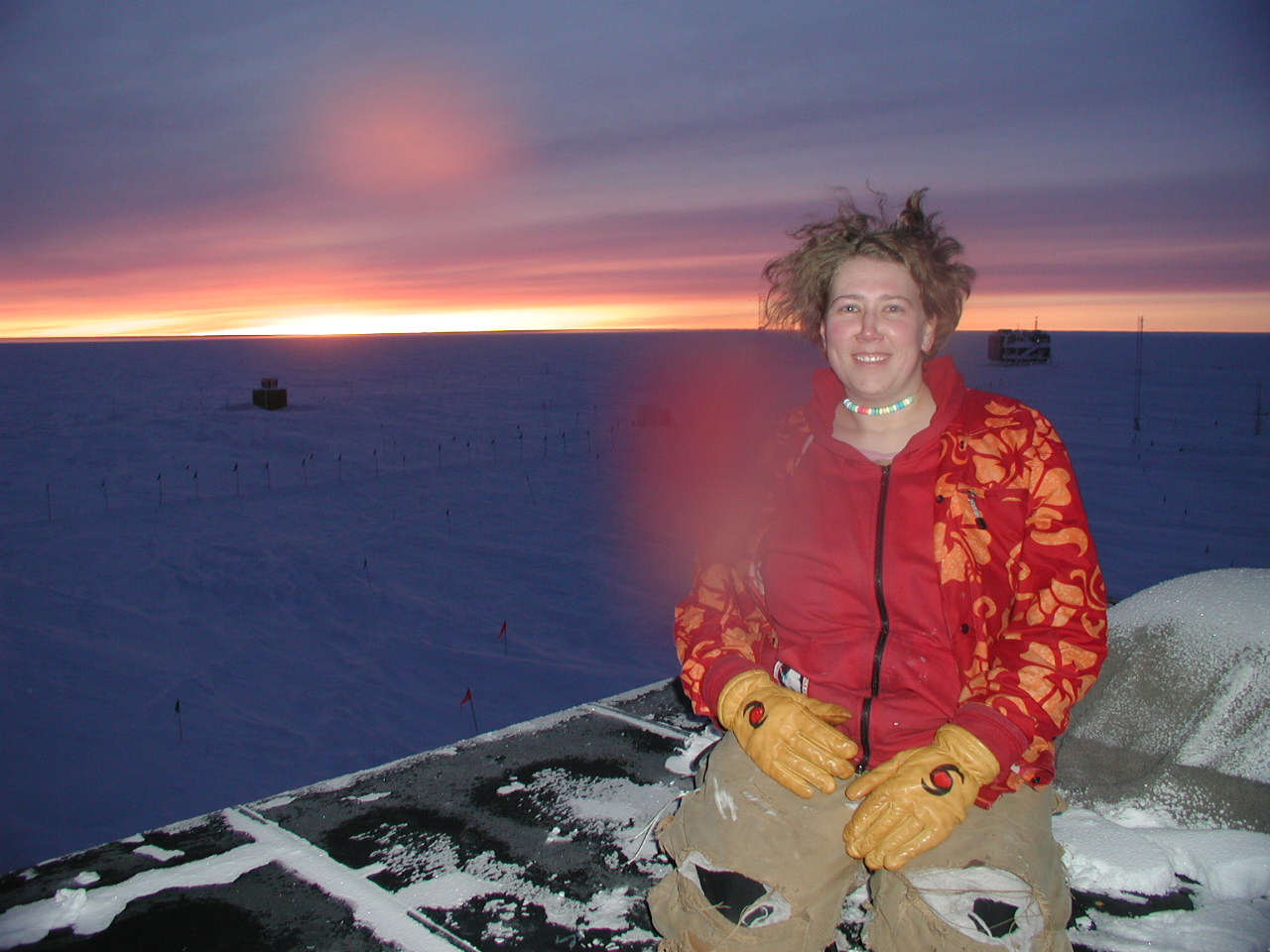
So I signed up for a gig at the south pole. I was a research technician, caring for and feeding 6 mostly automated research projects over the winter. Yep, I loves me some adventure. Here I learned the lesson be careful what you wish for, you just might get it.


I was beamed back to earth, dazed (to put it mildly), and with a newfound love of weather. I went to work as a weather observer on Mount Washington, home of the world's worst weather. The world record wind speed (231 mph) was measured there in 1934. Damn that place is windy! My "personal best" was 140 mph. Then I moved into a staff scientist position in the valley research office and digitized 70 years worth of weather observations.


Then I saw an ad for a PhD position digitizing old weather observations in the Institute for Atmospheric and Climate Science at ETH (sort of the the MIT of Europe) in Zurich Switzerland. And here I am, getting some more instruction in be careful what you wish for (one, two, three, four)... But this life of typing quietly to myself is a bit hard on my back and my eyes and my soul, so as we know I've decided to become a public school science teacher.


I've had a paying job of one type or another since I was 14. I have never not worked. Sometimes I fantasize about it would be like to be unemployed or retired. I've worked as a warehouse order-filler, a daycare attendant, a library clerk, at a movie theater, at a video store. I've done temp work in offices and department store returns. I worked as a secretary and a customer service rep for an industrial magazine publisher. Can you tell that I have a short attention span? And that perhaps I misinterpreted the encouragement "You can do anything you want in life" as "You should try everything in life"?


As to the careers I've considered pursuing? A, perhaps, unknowably large number.


My favorite job, bar none, was at the video store. I loved that store. I liked the coworkers, I adored and respected my boss, I liked (most of) the regular customers. I loved that I was getting paid to stand around talking about movies, watching movies (free tape!), repairing broken tapes, and, best of all, just interacting with people all day. I've always seen myself as an introvert and reliably test that way on personality "tests", so it was a bit puzzling that I always loved my retail and customer service jobs. I've recently seen that paradox from a new perspective: in work, I am an extrovert. I like to interact with people. In my private life, I'm in introvert. I find socializing kind of tiring, especially if I don't know you. I feel uncomfortable with unstructured interactions with strangers, but when I know my role, what's expected of me, I excel in dealing with people. And I love people. We are all such fascinating creatures, each of us living out the same storyline (be born, live, die) and wanting the same things (food, shelter, love) but none of us with the same details or tactics or outcomes.


I am excited to embrace this new side of me, and to let myself flower and use all of my natural skills and talent. I am looking forward to the next chapter in this story.


For the May, 2008 Scientiae.
Tag:

Labels: , ,

Thursday, April 03, 2008

A ton of feathers

I just returned Lifting a ton of feathers by Paula Caplan to the library. I have library issues. I love libraries. I love the idea of them, and I love being in them. I worked in 2 college libraries for a total of about 3 years and I loved it. But, I'm not a very good patron. I always check out more books than I can read by the due date, and I have some bizarre chore-avoidance issue that flares up and I can never, ever remember to get my books back on time. My late fees pile up so high it's cheaper for me to just buy books. Bad, Andrea!

I got this book with the intention of joining in a virtual book club about it over at ScienceWomen. March was a wee bit busy for me, though, and I didn't get very far in the book. In fact, I'm so far behind on blogreading after my trip to Tromso that I haven't even read the other posts about it!

I had trouble finishing the book for a couple other reasons. One is I'm having trouble reading small typefaces still (just started my eye PT last Friday), but the other is I found the content so depressing I just couldn't bear to pick it up. The book is about women in academia, and it's meant to be supportive in the sense that "knowledge is power" and it does have a ton of great advice. But I just couldn't get past the whole bigger problem of it. The fact that we need this book to begin with, and the vast extent of the problems addressed in it. It's overwhelming.

I guess I'm also a bit bitter about the whole issue right now. For many years I kept being told that if we just get more women into science, we'll reach a critical mass, and the whole culture will start to change. Reading Virginia Valian's book Why so Slow opened my eyes to that being a lie. There is a deeper problem that both men and women value women's input less, and respect us less, etc, that underlies everything. It's no longer enough to just keep packing women into the pipeline, letting each one of us flounder about wondering why we, individually, seemed to like it less than many of our male colleagues. I know so many women who have left science, but almost no men. Yes, that is totally anecdotal, but the statistics back that up.

Just today at our group meeting a colleague gave a practice talk, and I found myself silent. Normally I'm the first one to pipe up with comments and suggestions, but I just couldn't bear it today. The stares, the silence, and knowing that my suggestions are never implemented. I don't expect all my ideas to be used all the time, but when I see, month after month, that my ideas are always the ones to be glossed over, it gets tiring. It could just be coincidence that I'm the only female in the group, but Valian's book convinced me otherwise.

I also wasn't so motivated to read it because I'm pretty burned out on academia in general and have already decided to leave it after I graduate. I've totally lost perspective on the "pros" of academia and see mostly the "cons", so a whole book of cons and how to fight them was just too much.

For example, a new study came out recently about sexism in peer review. The Women in Science blog have a nice writeup about it. Normal peer review in science is single blind--the authors don't know who the reviewers are, but the reviewers see the authors' names. There was one ecology journal that changed its review process to be double blind and after several years Amber Budden looked at how many women were published--it had increased dramatically. No other ecology journal showed an increase over the same time period. It's incredibly depressing.

I think I might have avoided late fees, though, so it's not all bad!

And I've made a decision about what I want to do next. I've really been struggling with that for a long time, but the spiritual exercises I did in February and March really helped clarify things for me. I've decided I want to teach high school science, in particular to under-served kids. I know I'd be an awesome teacher, and it's also really important to me to feel like I'm contributing something. That the world is a better place, in however small a measure, because I was in it. I also feel like it will start to integrate the different parts of my life. Teaching feels like a calling to me, and is in harmony with my values and religious beliefs. It also promotes social and environmental justice, both of which are extremely important to me. Van Jones (here and here and here) is one of my big heroes right now. Ok, this might be the most stilted paragraph about something that I'm actually incredibly excited about. I should post the mind map I drew about teaching. The "so exciting it actually paralyzes me with looking-forward-ness" part totally grew and grew and overtook the "bad" or "fear" parts.

Labels: ,

Wednesday, December 12, 2007

Lessons in humilty

Living in Zurich has been a series of lessons in humility. Some of them are general expat-ness, but others seem to be just random. They all seem to revolve around losing a sense of my competency in life. Not being able to read my mail or get telephone numbers from a voicemail. Not knowing how to pay a bill or change a fuse. Not being able to find shoes in a shoestore. Shopping like a bewildered foreigner--hours spent wandering the aisles in frustration, trying to imagine how else item X could possibly be envisaged (and thus which section of the store would have it)--and this not changing at all after 2.5 years--I still shop like I just got off the boat.

I'm feeling it a lot at work, too. In every job I've ever had I've generally played certain roles, such as being the equipment/instrumentation person, or being seen as a resource for using certain pieces of software. Here I don't fill any of my old roles, and it's disorienting and makes me sad. I also experience the silencing effect of being female far more intensely here--that when I speak up in groups people (at best) ignore me or (worse) literally talk over me (seriously they just start talking as though I weren't in the middle of a sentence and still speaking). There have been meetings at work where I just said the same thing 5 times in a row because I was getting no response. This taps into a real problem vein for me--I have a hangup about wanting to be heard, to be understood, and when I'm having a conversation with someone that I can see is going awry, I get really attached to making sure they understand my meaning. This means I wind up repeating myself, ever more forcefully, and it means I wind up in a lot of "arguments" because I can't let go of the idea of making sure they see my point from my perspective.

I had a bad day at work yesterday. At our weekly group meeting someone presented a side project they have been working on for several months. I listened in shock as they described reinventing a wheel I'd already invented at my last job--I have about 2 years experience doing literally exactly what this person in my group is doing. [ETA: And my group knows this--in fact that experience is the primary reason I was offered the position here.] I had no idea, and it really bruised my ego that no one had ever once asked me for advice. This is the heart of my experience here--that I feel as though I have nothing to offer (or at least, that no one recognizes that I have anything to offer). I try not to take it personally--it is their loss, after all, but it does go on day after day and it sort of weighs on me.

I probably needed to have some lessons in humility, though. It's had some good effects. I'm far more detached from things--I'm much more able to see things happening and just let them go on without needing to get involved. Yeah, I've learned to mind my own business. Ha. I've also become way more relaxed about life's administrative duties. I'm one of those people who has never cut class in my life. I've missed class, from being sick or whatever, but I've never just woken up and thought, Nah, I'm not gonna go today. I attend to bills and such obsessively. I'm kind of high strung that way. The most frequent advice I've heard in my life is to "take it easy" and "not take it so personally". Don't you think, if I could, I would?!?! But now, here, I've turned into one of those people who throws away letters from the landlord with barely a glance. My policy is, if it's in German and overly wordy, I toss it. Short German things I'll read, but when I see a dense page full of specialized administrative or technical vocabulary that's not in the dictionary, I just dump it. I've come to believe that if it's important enough, they'll either write or call again, or someone will clue me in (Didn't you get the email about the mandatory meeting that starts in 5 minutes?).

My entire experience here is colored by my lack of ability to speak and understand German. This has turned out to be a pretty traumatic item which I will leave for another post.

Labels: , ,

Friday, October 12, 2007

Oh yeah

AND this week I sent off my professor application!! It's a pretty exciting accomplishment for me that I even applied--I waded through all the hours of low self esteem and managed to finish the application and send it in! And today I submitted my first paper for publication for my PhD. We have to publish 3 papers, and I have only 9 months left (eep!!). This feels like a big milestone, since the second paper is half written. I have only 1.5 left to do, rather than 3.

Labels: